Friday, August 30, 2013

Fancy-Shmancy Wall Decor

A new school year has begun!  It seems like each year I return to my office, I look for new ways to get organized and make my place of labor a little more inviting.  During the year, I constantly scour the aisles of Target looking for something fun, cute, and practical to hang on the plain walls of my office.  Maybe I'm too picky, but it's rare I find something I want to look at every day for years to come.  

Luckily, there are stationary stores that sell fancy-shmancy sheets of hand-made, beautiful paper!  Near us, we have a Paper Source where you can buy individual sheets of paper in more colors and prints than imaginable.  Let these words just flow through you...chevron, damask, marble, peacock!  Are these just the finest sounding sheets of paper you have ever heard?!  Can you imagine creating wall art with a sheet of mustache paper or a vintage-inspired sheet of London paper?  Too cute!  


Get into a stationary store, invest $3-8 in a sheet of fancy-shmancy paper, pop it into a large frame, and voila! 


You can create hanging wall art that is chic and one-of-a-kind!  Get a water-based Sharpie pen to double your art as a dry erase board.  


Happy new school year!

Saturday, March 30, 2013

Therapy Straight off the Hook

 Have you noticed that this time of year our students start falling into a mid-year rut?  The semester is in full swing, spring break is still a week away, and the interests of the students on our caseload are slowly dissipating.  If you can relate, it may just be time to spice up therapy.  And what better way to do that than by adding a little...flare.  Enter...


In all seriousness, slang and figurative language is an important piece of language use, as it is embedded within music, movies, TV shows, etc.  Even many animated films (think Ice Age) contain figurative language.  Many individuals with language impairments struggle to interpret such language.  Understanding and using slang is equally important for students with social cognitive deficits who have difficulty interacting with their peers and making friends.

So, what can we do with these silly cards you ask?  Well, one idea is to use a card or two as a warm-up activity to gain attention, elicit discussion, and add some fun to the therapy session.  Although some of the slang included in these cards is quite common, you'd be surprised how many students are not familiar with the terminology or expressions.  And the best part is, not only is the slang age-appropriate (used by much of their peer group), it is also hilarious (thanks to the fine illustrations).


Here are a few "fly" ideas for incorporating the cards into therapy:
 - use the context to determine the meaning of the word or phrase
 - locating/discussing part of speech, synonyms, multiple definitions
 - formal vs. informal language...how would you say this to a more mature audience (e.g.,   
    grandmother)
 - create a "slang-of-the-week" board as a conversational piece
 - slang vocabulary worksheet


You can find these cards on KnockKnockStuff.com or even Amazon.com.  They are around $10 and well worth it, based on the hilarity of these cards alone.

Be sure to flip through the card deck and separate any cards that may not be appropriate for your students before using, and enjoy!

Wednesday, February 6, 2013

I Heart Valentine's Magnets!

Nothing says February like candy hearts, so why not use them to express your love on your bulletin board or fridge?!  Just hot glue candy hearts to small magnets...I got the magnets at Michaels this time.  You can coat them with Mod Podge to give them a polished look, or leave them raw!!  Also, got some fun ribbon to tie into bows and glued them to magnets too. 


Wednesday, December 12, 2012

Holiday Eye Candy

'Tis the season to decorate your fridge, speech room, or classroom with festive decor!  Also, these peppermint magnets make a great gift for your favorite teacher, therapist, or neighbor!  Inexpensive and takes less than 5 minutes to make a jarful!

Start with some self-adhesive magnets from Wal-Mart...inexpensive at about $2 dollars for about 20 magnets...and a package of peppermint candies from the candy aisle...  remove the sticky paper, stuck them to the candies, and done!     


Great thing about this gift is its way more practical AND more diet friendly than just a jar of candy!  Throw them in a mason jar with a ribbon and you have given someone some "fridge eye candy".


Happy Holidays and Merry Magnets!

Sunday, December 9, 2012

Splash the Cash & Shop 'til You Drop!

It's time for some retail (I mean, speech) therapy!

No matter what holiday you celebrate, this time of year is jam packed with spending, shopping, and deals n' steals.  Coupons, ads, and catalogs come rollin' in and there is no escape from the potential spending spree which will leave us spent and reeling.  So, let's splash the cash and enjoy ourselves!

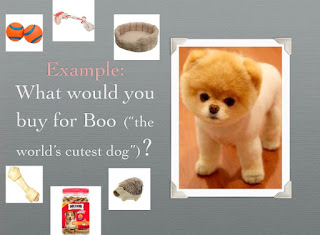
Here is an activity that can be used during speech-language therapy to focus on a variety of speech and/or language intervention targets, such as vocabulary (budget, retail, gift, cheap, expensive, purchase), perspective taking, etc.  We created a shopping list worksheet to use with a variety of catalogs and ads (e.g., Target; Bed, Bath, & Beyond; Ulta; Toys"R"Us; etc.).  We gave our students a budget and asked them to list five people they would like to  buy gifts for.  The students perused catalogs and ads to find the perfect gifts.  This required discussion about taking perspective and using the information we know about each of the individuals on our lists to determine what gifts they would enjoy.  Some of the points we discussed are included in the slideshow below.

You can be as creative as you'd like with the shopping list worksheet.  There are three boxes at the bottom of the sheet which can be used a variety of different ways.  You can have the students:
  • cut & paste pictures from catalogs/ads of their three favorite "finds"
  • cut & paste pictures of their three best deals or lowest priced items
  • draw pictures of three places they will shop
  • draw pictures of three gifts they would like to receive
  • write three sentences about gifts they will purchase
The slideshow below can be used as a warm-up activity to get the students thinking about gifts that can be purchased for others based on factors, such as age, gender, interests, etc.  We chose a few celebrities to purchase gifts for and brainstormed as a group what types of gifts would be appropriate/inappropriate based upon what we know about each individual.  We concluded our dialogue by discussing gift giving/receiving etiquette (e.g., What should you say if someone gives you a gift you do not like?).

So, peruse, shop, & enjoy!

Click here to download the shopping list template.

Click here to download our Gift Buying Guide slideshow.

Tuesday, November 20, 2012

Leftover Candy Corn??...Thanksgiving Bingo!

Mounds of post-Halloween candy corn got you seeing orange?  Use them as Bingo chips!!! The prize for the winner??...they get to eat their candy corn bingo chips! 

This is a great activity for Thanksgiving day with the kids OR as a post-Thanksgiving speech therapy activity. 

For your kids: I give the kiddos this Bingo game, and they are outta my hair while I frantically fish giblets out of the turkey and burn pies.  I print out the boards, cut one up to use as the pictures that are called, give the kids a handful of candy corn and have them play until they run out of their handful or throw up, whichever comes first.  I've learned that giving just a handful usually prevents this and corn is in the veggie food group anyways.  They take turns choosing pictures and being the "bingo caller" and the candy corn are used as the Bingo chips.

For speech therapy: its a great way to target various needs:
  • Articulation: students generate a sentence for the picture that is chosen before they put a "chip" on it, making sure they are producing the "target sound" correctly.  Also great for the goal of production of 2-4 syllable words, or CVC/CVCV/CVCVC words. 
  • Langauge: Use bingo pictures for sentence formulation, including targeting verb forms, subject-verb agreement, using conjunctions, pronouns, etc.  Also perfect for vocabulary.
  • Pragmatics (Social Language): Students can practice asking each other questions, answering by using the Bingo item chosen when its their turn (e.g., when a student chooses "stuffing", they have to ask another student a question, such as "Did you eat stuffing at Thanksgiving?" or "Do you like pumpkin pie?")
Print out the bingo boards below and get rid of that candy corn just in time to make room for holiday goodies!!!


Happy Thanksgiving!

Monday, November 5, 2012

Chitchat Time

Many of the students we see are working on conversational skills, such as initiating and maintaining conversation with peers and other individuals.  This can be quite difficult, especially for students with Autism Spectrum Disorder (ASD).  Some of the challenges of conversational skills revolve around difficulty with taking-perspective, making inferences, as well as other pragmatic language skills.  It is also quite common to have students who are able to initiate and maintain a conversation when the topic is of interest to themselves (e.g., dinosaurs, Civil War, etc.).

We made an easy and fun tool that can be used during social language groups to provide students with a variety of conversational topics.  You can choose any topics you feel would suit the interests of your students best.  Since we work with high school-age students, we made cards for the following topics:

  • Music
  • You Tube
  • Favorite Class
  • In-N-Out (This is surprisingly an all-around, favorable topic)
  • Skateboarding dog
  • Weekend Plans
  • Team Edward vs. Team Jacob
  • Recent Movies
  • Angry Birds
  • Pets
  • Facebook
  • Beach
  • 2012 Olympics
  • American Idol
  • PlayStation
  • Sports


For the conversation cards, we found images of each topic we wanted to include, then cut and pasted them on 5x8 index cards.  We laminated the cards then hole punched them to put on a ring.  For students who have difficulty formulating questions and/or making comments, you can place a prompt on the back of each card.  A few of the prompts we used were:

                   "Do you like _________?"
                   "What is your favorite __________?"
                   "That's cool."
                   "I like that too."


The conversation cards can also be used to practice making small talk.  We used a few of the more general topics (e.g., pets, weekend plans) to discuss the topic of small talk and brainstorm questions and statements that could be used to initiate small talk with various individuals.

What are some of the topics you would choose?